Medical document management stands at the critical intersection of modern healthcare delivery and rigorous administrative safeguarding, demanding our immediate professional attention. Beneath the humming fluorescence of bustling emergency departments and the quiet corridors of specialized clinics, a silent revolution unfolds every single day as institutions strive to protect their most vulnerable assets.
Every keystroke, scanned chart, and archived file tells a profound human story of healing and resilience, proving that meticulous organization directly translates to saved lives. By transforming chaotic archives into streamlined digital vaults, healthcare professionals pave the way for a brighter, more secure future where patient wellbeing remains uncompromised by bureaucratic hurdles.
Healthcare facilities must navigate the labyrinth of historical chart archiving while preserving patient safety

Source: aimprosoft.com
Every single day, hospitals and outpatient clinics carry the immense responsibility of balancing tomorrow’s breakthrough treatments with yesterday’s paper documentation. Stepping into the realm of medical record modernization requires more than just scanning pages; it demands a meticulous strategy that safeguards clinical continuity. When a physician reaches for a patient’s historical chart during an emergency consultation, milliseconds matter, and the integrity of that data cannot be compromised by digital migration friction.
Transforming decades of dusty, yellowed paper archives into encrypted, lightning-fast digital repositories is a delicate orchestration of clinical operations and advanced IT engineering. This evolution moves far beyond simple optical character recognition. It relies on hybrid migration pipelines where clinical informaticists work alongside software architects to index, validate, and securely ingest legacy charts without halting the heartbeat of active hospital wards.
Technicians implement phased extraction schedules, running batch scans during low-census overnight hours while staging virtual chart replicas in parallel viewing systems. Clinicians retain uninterrupted access to patient histories through embedded viewer bridges within the electronic health record interface, ensuring that ongoing therapies, historical medication allergies, and chronic condition baselines remain visible at every stage of the digitization journey.
Migration bottlenecks and software remedies in clinical data transformation
Modernizing healthcare infrastructure inevitably introduces operational friction points that test the resilience of hospital IT departments and clinical staff alike. Addressing these friction points requires targeted technological interventions that protect both data integrity and daily patient care workflows, ensuring that the transition from paper to pixels enhances rather than hinders medical excellence.
The following table Artikels the critical obstacles encountered during large-scale medical record migration, alongside their corresponding software-driven solutions.
| Migration Challenge | Clinical Impact | Software Remedy |
|---|---|---|
| Unstructured and handwritten legacy notes causing indexing failures | Delayed chart retrieval during critical moments, risking misdiagnosis or delayed emergency interventions. | Advanced Optical Character Recognition powered by machine learning algorithms trained specifically on medical handwriting. |
| Data format incompatibility between legacy proprietary databases and modern Electronic Health Record systems | Siloed patient histories that force clinicians to toggle between multiple disconnected applications. | Automated data mapping pipelines utilizing HL7 and FHIR interoperability standards to unify historical and current records. |
| Strict regulatory compliance and HIPAA audit trail requirements during transport | Vulnerability to data breaches and potential non-compliance penalties during transit phases. | End-to-end AES-256 bit encryption combined with immutable blockchain audit logs tracking every file access. |
Operational framework prioritizing patient records based on readmission frequency and legal retention mandates
Resource allocation during a massive record digitization initiative must be guided by a strict hierarchy of clinical relevance and legal necessity. Attempting to digitize an entire medical library simultaneously often leads to system bottlenecks and inflated error rates. Healthcare institutions achieve optimal operational efficiency by deploying a tiered triage matrix that evaluates files through a dual lens of patient vulnerability and regulatory obligation.
The strategic prioritization of legacy archives follows a structured operational methodology:
- Tier one encompasses active patients with high readmission frequencies, particularly those managing chronic conditions such as congestive heart failure or end-stage renal disease, requiring immediate, high-priority digitization and seamless EHR integration.
- Tier two targets medico-legal retention mandates, focusing on pediatric records that must legally remain accessible until the patient reaches adulthood, alongside oncology and surgical files with extended liability windows.
- Tier three involves dormant records nearing the end of their statutory retention periods, which are batched for secure, long-term cold storage or compliant destruction without active clinical mapping.
Data governance in healthcare is not merely a legal checkbox; it is a direct extension of the patient bedside, where the availability of a well-preserved historical chart can alter the trajectory of a life-saving intervention.
Physical transformation of legacy record rooms into modern server environments
The metamorphosis of a hospital’s basement record room serves as a powerful testament to the broader digital revolution sweeping modern medicine. For decades, these subterranean spaces were characterized by towering metal shelving units bowing under the weight of cardboard boxes, smelling of aging wood pulp, and echoing with the footsteps of clerks searching through alphabetical paper tabs by flashlight. Dust motes danced lazily in the dim fluorescent glow, masking potential hazards like humidity pockets, mold spores, and pest damage that threatened the physical longevity of irreplaceable patient histories.
Security was maintained by heavy steel doors and manual sign-out clipboards, leaving records vulnerable to localized environmental disasters or unauthorized physical handling.
Today, that very same physical footprint has undergone a breathtaking structural and technological renaissance. The damp, sprawling expanse of paper storage has been stripped down to bare concrete, treated with antimicrobial sealants, and reborn as a pristine, climate-controlled tier-three data vault. Rows of high-density server racks now stand where steel shelving once rested, their internal blade servers humming a quiet, rhythmic tune of perpetual data processing.
Industrial-grade HVAC systems maintain an unyielding atmosphere of precisely sixty-one degrees Fahrenheit and forty-five percent relative humidity, ensuring optimal hardware lifespan and data media stability. Overhead, advanced gaseous fire suppression systems replace antiquated water sprinkler pipes, ready to extinguish electrical anomalies instantly without drenching the hardware. Access is strictly governed by biometric retinal scanners and multi-factor electronic keycards, transforming a once-vulnerable basement storage dungeon into an impenetrable fortress of secure digital healthcare intelligence.
Practitioners often struggle to reconcile rapid clinical documentation with rigid institutional retention schedules.

Source: folderit.com
In the high-stakes environment of modern healthcare, the pulse of patient care beats entirely against the unyielding clock of administrative governance. Clinicians race through hospital corridors, capturing vital observations in fleeting moments between life-or-death interventions, while compliance officers sit in quiet offices measuring those exact notes against decades-long legal mandates. This invisible tug-of-war pulls healthcare professionals between the moral imperative of immediate bedside care and the bureaucratic weight of archival longevity.
The friction between rapid clinical note-taking and long-term compliance governance creates a daily operational fracture across emergency rooms and intensive care units alike. When a physician dictates a discharge summary at midnight, their primary focus remains tethered to the patient’s immediate physiological trajectory and the next oncoming shift. Conversely, hospital legal teams view that very same document through a multi-decade lens of statutory liability, accreditation standards, and potential malpractice litigation.
The physician desires speed, clarity, and minimal friction to prevent burnout and ensure timely handoffs, whereas the compliance department demands rigid standardization, exhaustive completeness, and unyielding adherence to retention schedules that often outlive the technology used to author them. This dichotomy frequently results in incomplete records, administrative resentment, and a systemic vulnerability where vital historical context gets lost beneath piles of hastily saved digital files.
Bridging this chasm requires an architectural shift in how healthcare institutions perceive documentation, moving away from a punitive auditing mindset toward an automated ecosystem that protects both the exhausted caregiver and the legally bound hospital.
A seamless documentation workflow does not ask clinicians to become archivists; it transforms the electronic health record into an intelligent partner that respects both human fatigue and legal permanence.
Automated Daily Routine for Clinical Note Retention
Eliminating the administrative burden from exhausted frontline nurses requires an intelligent workflow that operates silently in the background of daily hospital operations. Implementing a structured, automated daily routine ensures that every piece of clinical data finds its proper archival home without demanding manual intervention from practitioners who are already stretched to their absolute limits.
- Shift Change Synchronization: As midnight approaches, the electronic health record system initiates a background daemon that scans all newly finalized shift notes, matching patient identification tokens against current inpatient status registries to flag records requiring active preservation.
- Metadata Extraction Protocol: Natural language processing algorithms automatically parse the clinical text within each saved note, identifying key diagnostic terms, pharmacological interventions, and acuity markers to assign preliminary retention tags.
- Compliance Validation Sweep: The automated engine cross-references the tagged records against institutional retention schedules and regional statutory requirements, locking the metadata profiles to prevent premature deletion or unauthorized alteration.
- Secure Vault Ingestion: At the conclusion of the automated cycle, all processed files are cryptographically sealed and transferred to long-term cold storage repositories, generating an immutable audit log for hospital compliance officers to review at their convenience.
Metadata Taxonomy for Clinical Output Organization
The sheer volume of modern medical data means that unorganized digital files are effectively lost files, hidden in plain sight within bloated hospital servers. Establishing a sophisticated metadata taxonomy acts as a digital compass, instantly guiding medical staff and legal teams to the exact document they need by slicing through administrative chaos using precise structural markers.
When patient outputs are systematically organized according to diagnostic urgency and treating physician credentials, the entire trajectory of patient care becomes traceable and secure. For instance, a critical trauma file originating from an emergency department physician is automatically stamped with a high-priority diagnostic urgency index and linked securely to the attending board-certified trauma surgeon’s National Provider Identifier. This dual-layer classification ensures that files associated with high-risk interventions are routed to high-security, long-term retention tiers, while routine outpatient notes follow standard short-term archiving paths.
Furthermore, this granular categorization prevents catastrophic misplacement during external audits or legal discoveries, as every document carries an indelible digital fingerprint detailing who created it, why it was created, and how urgently it must be preserved. By categorizing clinical outputs through this multidimensional taxonomic lens, hospitals transform chaotic digital warehouses into navigable, highly secure information archives that uphold the highest standards of patient safety and institutional accountability.
Compliance Pitfalls During Routine Patient File Audits
Internal audits often reveal dangerous blind spots that leave healthcare facilities vulnerable to severe regulatory penalties and compromised patient safety records. Hospital administrators must remain vigilant against recurring oversight errors during routine file evaluations.
- Failing to update retention schedules when state or federal statutory mandates change regarding specific infectious disease documentation.
- Overlooking orphaned records left behind by departed staff members whose credentials were never unlinked from archived patient files.
- Neglecting to audit the encryption status of historical metadata archives, leaving older files exposed to unauthorized internal access.
- Disregarding the completeness of audit trails for emergency overrides, where rapid documentation bypasses standard compliance checks.
- Failing to reconcile physical paper scans with digital electronic health record archives, creating dangerous discrepancies in the patient’s chronological history.
Interoperability bottlenecks between disparate departmental software platforms threaten holistic patient care coordination.
Modern medicine relies heavily on seamless data flow, yet hospital ecosystems often resemble fragmented digital islands where critical patient information gets trapped behind proprietary walls. When specialized software systems cannot talk to each other, the resulting communication breakdowns create invisible hazards that jeopardize treatment efficacy and compromise overall patient safety across the entire continuum of care.
Consider the high-stakes environment of a bustling metropolitan emergency department during a midnight trauma shift. A patient arrives with crushing chest pain, requiring an immediate review of previous cardiac interventions stored in the cardiology department’s specialized imaging archive. However, because the emergency room charting platform runs on a legacy vendor architecture that rejects external data packets, the vital DICOM images remain locked away.
The attending physician stares at a blank viewing window, forced to make life-altering decisions relying solely on verbal patient history while digital roadblocks actively stall timely diagnostic clarity.
Friction points emerging when cardiology imaging software fails to communicate with emergency room charting systems
The operational friction between advanced cardiology imaging repositories and emergency room documentation interfaces manifests through distinct technological barriers that routinely disrupt clinical workflows. Identifying these specific friction points allows healthcare IT architects to target interventions where data loss occurs most frequently during acute medical evaluations.
- Proprietary file encapsulation locks high-resolution angiograms and echocardiograms inside vendor-specific wrappers that standard emergency room viewing software cannot unpack or render natively.
- Unsynchronized time-stamps between standalone cardiology workstations and emergency department master patient indexes trigger severe metadata conflicts, occasionally causing conflicting chart entries for simultaneous procedures.
- Bandwidth throttling during massive data transfers of multi-gigabyte cine-angiography files causes emergency room terminal timeouts, abruptly severing active viewing sessions right in the middle of critical trauma assessments.
- Absent bi-directional alerting protocols mean that updated cardiac risk stratification scores generated in specialized imaging suites never automatically push notifications to the active emergency room triage dashboard.
Middleware integration methods translating proprietary file formats into universally readable hospital database entries
Bridging the chasm between isolated departmental software requires sophisticated middleware orchestration that acts as a universal digital translator for complex clinical datasets. This architectural layer intercepts proprietary data streams at the server level, deconstructs closed-source file structures, and maps every physiological parameter into standardized HL7 and FHIR formats. By standardizing incoming payloads before they hit the enterprise electronic health record, middleware ensures that cardiological visuals and emergency notes merge into a single, cohesive timeline without requiring a total overhaul of existing departmental infrastructure.
The transformation engine operates through continuous background parsing protocols that normalize disparate data types into universally accepted hospital database schemas. Visualizing this process reveals a continuous stream of raw, incompatible binary data flowing from the cardiology suite into an illuminated processing hub, where automated algorithms strip away proprietary headers and reassemble the visual assets alongside time-coded clinical annotations. The resulting output emerges as a clean, standardized database entry instantly accessible from any authorized terminal across the health system.
Universal data translation through enterprise middleware transforms isolated departmental archives into accessible clinical intelligence, turning digital barriers into pathways for safer patient outcomes.
Technical architecture comparison across hospital data exchange models
Selecting the optimal framework for enterprise health data exchange demands a rigorous evaluation of legacy constraints, maintenance overhead, and real-time processing capabilities across various architectural models.
| Integration Approach | Core Operational Mechanism | Primary Failure Risk | Typical Latency Profile |
|---|---|---|---|
| Legacy Data Bridges | Point-to-point scripted flat-file transfers via local area networks. | High vulnerability to custom interface engine crashes during system updates. | Medium to High (minutes to hours) |
| API Middleware | RESTful endpoints utilizing standardized FHIR resources for payload translation. | Rate-limiting bottlenecks during peak emergency department admissions. | Low (near real-time) |
| Cloud Native Pipelines | Containerized event-driven microservices operating in scalable serverless environments. | Complex security compliance and external network dependency vulnerabilities. | Ultra-Low (milliseconds) |
| Direct Database Injections | Raw SQL queries executing direct table modifications bypassing application layers. | Catastrophic database corruption and referential integrity violations. | Immediate (variable stability) |
High stakes surgical scenarios complicated by fragmented database records
The true peril of interoperability bottlenecks surfaces most dramatically during intricate surgical interventions where missing diagnostic data can alter an entire operative strategy. Real-world clinical incidents consistently demonstrate how segregated software environments create dangerous blind spots for surgical teams operating under intense time constraints.
During a complex aortic valve replacement at a major regional medical center, the multidisciplinary surgical team prepared to initiate bypass while relying on the primary electronic health record interface. Unbeknownst to the perfusionist, a critical update containing recent anticoagulant lab results performed in a satellite hematology laboratory failed to synchronize with the main intraoperative dashboard due to a routine API queue timeout in the middleware layer.
As the surgical team progressed toward the critical phase of the procedure, the absence of this vital coagulation panel nearly prompted the administration of standard-dose heparin that could have triggered catastrophic, uncontrolled hemorrhaging in a patient with an undiagnosed hypercoagulable state.
Just minutes before the irreversible surgical step, an anesthesiologist noticed the data discrepancy and initiated an emergency phone consultation with the core laboratory, manually retrieving the missing values to avert a near-disastrous complication. This harrowing near-miss underscores the urgent necessity for robust, fault-tolerant integration pipelines that guarantee zero data packet loss between specialized departmental platforms and active surgical suites.
Unstructured clinical notes present formidable hurdles for automated indexing routines and retrieval engines.
Beneath the glow of late-night hospital monitors, a quiet battle rages between modern database architectures and the chaotic, deeply human reality of handwritten medicine. Millions of legacy records sit trapped in physical basements and fractured digital vaults, filled with hurried scribbles and idiosyncratic shorthand that defy traditional computing logic. Unlocking this vast ocean of clinical intelligence requires bridging the gap between raw, messy human expression and the rigid, orderly demands of modern medical administration.
The stubborn resistance of handwritten physician observations to standard text recognition algorithms and database categorization stems from a fascinating collision of human biology, art, and time constraints. Unlike pristine commercial fonts, human handwriting varies wildly depending on fatigue, emotional state, and the physical writing instrument used during a frantic midnight code blue. Doctors develop deeply personalized dialects—a blend of Latin roots, hurried abbreviations, and idiosyncratic symbols unique to individual clinicians or specific hospital wards.
When standard Optical Character Recognition engines encounter these cursive anomalies, the algorithms attempt to match jagged strokes against geometric templates that simply do not exist. Slanted loops are misinterpreted as numeric digits, overlapping letters merge into monolithic visual blocks, and contextual cues vanish because baseline optical scanners lack the clinical intuition to deduce that a shaky scrawl near a fever chart likely indicates a critical vital sign rather than a casual note.
Furthermore, paper degradation, fading ink, and bleed-through from cheap hospital stationary create visual noise that completely overwhelms basic pixel-mapping routines, leaving database categorization engines stranded in a sea of ambiguous data fragments.
Natural language processing transformation pipelines for clinical documentation
Transforming colloquial medical shorthand into structured, actionable intelligence demands a sophisticated computational choreography that decodes human nuance into machine-readable precision. As healthcare institutions modernize their archival workflows, advanced natural language processing architectures step in to parse the chaotic prose left behind by generations of clinicians.
The transformation journey begins with ingestion and tokenization, where raw text strings—whether extracted via advanced vision models or typed in a rush—are segmented into meaningful linguistic units. Next, a specialized domain-specific named entity recognition model scans the tokens, identifying clinical concepts such as anatomical sites, pharmacological agents, and temporal markers while discounting conversational filler. Once these entities are isolated, a context-aware word embedding layer evaluates surrounding terms to resolve ambiguous abbreviations; for instance, determining whether “MS” refers to multiple sclerosis or morphine sulfate based on adjacent symptom descriptions.
Following semantic disambiguation, the pipeline maps the normalized concepts directly into standardized medical terminologies, aligning the extracted data with universal billing codes and searchable database fields. This multi-layered translation turns erratic bedside notes into pristine, queryable assets that empower hospital administrators and researchers alike.
In the high-stakes environment of pharmacy dispensaries and acute care units, visual clarity can mean the difference between healing and harm. The transition from scanned prescription slips to digital databases is fraught with optical translation perils that demand rigorous quality control protocols.
The following optical character recognition errors commonly corrupt dosage quantities in scanned prescription slips:
- Strokes from adjacent letters merging with numerical digits, causing a standard dose of 5 milligrams to be misread as 50 milligrams.
- Decimal points disappearing into background page artifacts or folding creases, transforming fractional dosages into dangerously inflated integers.
- The lowercase letter ‘l’ and the uppercase letter ‘I’ being confused with the numeral ‘1’, resulting in misread liquid volume measurements.
- Slanted or bleeding handwritten slash marks in fraction-based dosages being stripped away by thresholding filters, misinterpreting half-doses as full units.
Accurate extraction of pharmaceutical quantities from historical medical records serves as the absolute bedrock of patient safety during large-scale data migrations.
Neural network architectures processing fractured physician notes
When the sun sets over sprawling medical campuses, server racks hum to life to execute an extraordinary nocturnal transformation of raw clinical history. Deep within these computational fortresses, multi-layered neural network models labor tirelessly to knit together decades of fragmented, unstructured physician notes into a seamless, chronological tapestry of human health.
The architectural engine driving this massive nocturnal synthesis relies on a hybrid deep learning framework combining convolutional layers and transformer-based attention mechanisms. Initially, distributed convolutional neural networks sweep across millions of digitized physician notes, acting as digital microscopes that isolate local stroke patterns, margin notes, and marginalia. Once these visual elements are translated into vectorized semantic embeddings, stacked bidirectional encoder representations take over to capture long-range dependencies across years of separate medical encounters.
These attention mechanisms weigh the significance of every clinical observation, connecting a casual lifestyle remark made in an outpatient clinic in two thousand and twelve with a complex cardiac event documented in an emergency room a decade later. Millions of fractured data points flow through recurrent memory cells, discarding duplicate entries, resolving contradictory diagnoses, and synthesizing a unified patient timeline.
The resulting digital chronicle provides treating physicians with an instant, comprehensive view of a patient’s medical journey, turning centuries of accumulated paper chaos into life-saving clarity.
Unauthorized access attempts targeting sensitive patient dossiers require multi-layered defensive engineering postures.: Medical Document Management
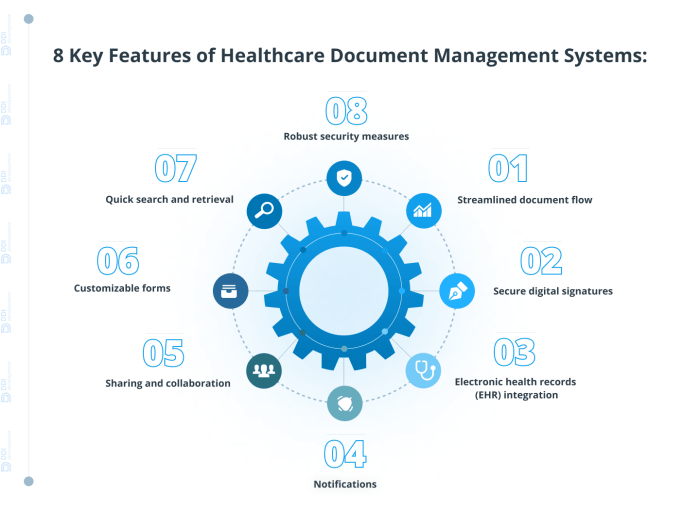
Source: ddi-dev.com
Modern healthcare ecosystems face an unprecedented surge in targeted digital incursions, where malicious actors continuously probe the perimeter of clinical data repositories. Safeguarding electronic health records transcends basic compliance; it demands an active, multi-tiered fortification of every digital pathway. When sensitive patient histories traverse complex network boundaries, they move through vulnerable digital corridors that demand absolute cryptographic supremacy to deter interception and unauthorized decryption.
Protecting the sanctity of human health data requires a harmonious blend of advanced mathematical algorithms and rigorous network architecture. As medical institutions migrate toward cloud-centric infrastructures and expansive health information exchanges, the attack surface expands exponentially. Implementing robust defensive engineering ensures that even if perimeter defenses experience coordinated strain, the core payload remains completely unreadable to unauthorized entities. This strategic approach preserves the sacred trust between caregiver and patient in an increasingly hostile cyber landscape.
Cryptographic Protocols for Cross-Facility Record Transmissions
Moving sensitive medical dossiers across disparate healthcare networks requires an impenetrable cryptographic shield to guarantee confidentiality, integrity, and authenticity. Without rigorous cryptographic enforcement, intercepted transmissions expose vulnerable patient identities to malicious exploitation and identity theft.
The foundation of secure electronic record transmission relies on the Advanced Encryption Standard operating in Galois/Counter Mode, commonly referred to as AES-GCM, utilizing robust 256-bit keys. This specific configuration ensures not only the absolute confidentiality of the medical data payload but also provides authenticated encryption with associated data to detect any tampering attempts mid-transit. When a regional medical center transmits complex oncology files to a specialized research university, the data undergoes rigorous encapsulation before leaving the local server rack.
As the encrypted packet initiates its journey across public and private fiber-optic pathways, Transport Layer Security version 1.3 establishes an ephemeral cryptographic handshaking sequence. This modern protocol eliminates outdated cipher suites and drastically reduces handshake latency, preventing downgrade attacks and eavesdropping from malicious intermediaries. Perfect forward secrecy is strictly enforced during this phase, ensuring that even if a master private key is compromised in the distant future, historical session keys remain utterly safe from retrofitted decryption efforts.
Navigating chaotic health records often feels like chasing shadows in a storm, yet clarity finally arrives through advanced occupational health software solutions 2026 that brilliantly illuminate workplace safety pathways. Today, embracing these digital innovations turns fragmented files into cohesive medical document management triumphs, empowering every organization to protect employee wellness with absolute precision and renewed operational confidence.
Furthermore, digital signatures powered by Elliptic Curve Cryptography validate the origin of every transmitted file, assuring the receiving facility that the data has neither been spoofed nor altered by an unauthorized actor. Hardware Security Modules deployed at both endpoints securely generate and store cryptographic keys within tamper-resistant physical processors. This multi-layered mathematical defense guarantees that patient identities remain mathematically invisible and functionally unbreachable throughout the entire electronic migration lifecycle.
To systematically manage and visualize these multifaceted defense mechanisms across institutional networks, security architects rely on structured threat mitigation frameworks that map vulnerabilities directly to actionable countermeasures.
The following matrix Artikels the critical alignment between persistent threat vectors, applied cryptographic standards, operational access thresholds, and immediate remediation steps.
| Threat Vector | Encryption Standard | Access Threshold | Remediation Steps |
|---|---|---|---|
| Man-in-the-Middle Interception | TLS 1.3 with AES-256-GCM | Mutually Authenticated Endpoints | Revoke compromised certificates, enforce strict certificate pinning, and rotate ephemeral keys. |
| Database Exfiltration at Rest | AES-256 with Hardware Security Modules | Role-Based Multi-Factor Authentication | Isolate affected server nodes, audit active database sessions, and re-key storage volumes. |
| Insider Credential Abuse | Attribute-Based Encryption (ABE) | Context-Aware Dynamic Authorization | Instantly revoke temporary access tokens, trigger behavioral user analysis, and initiate forensic logging review. |
Operational security extends far beyond algorithmic defenses, requiring strict administrative guardrails that dictate how human actors interact with sensitive digital repositories on a daily basis.
Consider a high-pressure scenario at a metropolitan oncology center during a major operational surge, where a temporary administrative staff member attempts to access restricted terminal patient dossiers without clinical authorization. The individual, assigned to basic appointment scheduling, navigates the electronic health record system and attempts to open detailed palliative care notes and genetic profiling charts of patients outside their assigned department.
The platform’s role-based access control architecture immediately evaluates the request against the user’s explicit credential matrix. Because the temporary staff member possesses credentials strictly scoped to front-desk scheduling attributes, the system denies the retrieval request in milliseconds. Concurrently, the integrated security information and event management system flags the anomalous query pattern, triggering an automated account freeze and dispatching an instant alert to the institutional data protection officer.
Navigating mountains of medical document management requires absolute precision and unwavering focus daily. Today, modern agencies streamline this critical burden using an advanced home health ehr to illuminate dark operational pathways. Ultimately, mastering secure medical document management empowers dedicated caregivers to transform chaotic paperwork into profound patient healing victories everywhere.
This swift, automated containment successfully prevents an internal data breach before sensitive patient information can be viewed, copied, or exfiltrated. The incident highlights the vital necessity of strict least-privilege enforcement, ensuring that temporary or fluctuating personnel maintain zero visibility into specialized clinical dossiers.
Database custodians operating at the intersection of advanced technology and profound human vulnerability carry an unmatched ethical duty that transcends standard regulatory compliance frameworks.
As guardians of terminal oncology records, database custodians do not merely manage digital bytes; they preserve the most vulnerable chapters of human dignity, where absolute confidentiality is a sacred moral imperative and every cryptographic key represents a solemn vow to protect the patient’s remaining legacy against exploitation.
Disaster recovery contingencies for catastrophic infrastructure failures demand rigorous offsite synchronization protocols.
When the grid goes dark and local infrastructure buckles under the weight of catastrophic failures, the lifeline of a medical facility depends entirely on its ability to bounce back without losing a single byte of critical patient data. In high-stakes environments, modern healthcare facilities treat data preservation not merely as an administrative chore, but as an absolute clinical imperative where every single record tells a story of survival and care.
The mechanics of real-time server mirroring for neonatal intensive care unit monitoring logs during a power outage rely on an intricate, highly resilient digital choreography. Imagine the delicate, rhythmic beeps of incubators tracking tiny heartbeats and fragile oxygen saturation levels; every microsecond of this telemetry data must be instantly duplicated to prevent any blackout in medical oversight. When primary hospital power fails, automated transfer switches trigger industrial-grade uninterruptible power supplies, keeping the primary servers alive while zero-loss mirroring protocols kick into gear.
Through dedicated fiber-optic rings running on distinct physical pathways, incoming log streams from bedside monitors are simultaneously written to local solid-state caches and packet-switched over to secure offsite data repositories located miles away. This byte-for-byte mirroring utilizes synchronous block-level replication, ensuring that the remote destination acknowledges receipt of every data packet before the local system registers the transaction as complete.
Because neonatal care leaves zero margin for error, advanced compression algorithms prioritize vital sign streams over historical metadata, guaranteeing that even if the main hospital facility suffers a total infrastructural collapse, nurses and physicians maintaining remote command centers retain uninterrupted, up-to-the-second visibility into every incubator.
In the theater of critical care, the seamless preservation of real-time telemetry is the invisible shield protecting our most vulnerable patients from the chaos of sudden infrastructural failure.
Data restoration speed testing through simulated ransomware attack drills
Proactive cyber-defense requires constant, rigorous stress-testing to ensure that technical teams can outmaneuver malicious actors who lock down hospital servers for extortion. Executing a controlled, simulated ransomware containment and data restoration drill validates the operational readiness of the entire information technology squad while exposing potential bottlenecks before a real-world breach occurs.
- Initiate the simulation by isolating the infected clinical database partition using software-defined networking firewalls to prevent lateral movement across hospital VLANs.
- Trigger the automated incident response script, which immediately alerts the chief information security officer and halts all write permissions on compromised storage arrays.
- Verify the integrity of the immutable, air-gapped backup snapshots stored in the secure secondary cloud vault to ensure the malicious payload has not infected historical restore points.
- Initiate parallel data stream recovery procedures, channeling clean virtual machine images into a temporary, sandboxed hypervisor cluster to measure throughput speeds.
- Execute database transaction log roll-forwards up to the exact timestamp immediately preceding the simulated malware injection, confirming zero data corruption.
- Conduct clinical application smoke tests with designated medical staff representatives to validate that restored patient charts display accurate, uncorrupted diagnostic histories.
Replication methodologies and financial investments for regional hospitals
Balancing the ledger against the unpredictable nature of disasters forces regional hospital administrators to make tough choices regarding how they duplicate their electronic health records. The architectural debate usually centers on choosing between the absolute protection of continuous data availability and the practical reality of operating within constrained institutional budgets.
Synchronous replication offers the gold standard in data protection by writing transactions simultaneously to both the primary local storage and the remote disaster recovery facility. This methodology guarantees a Recovery Point Objective of absolute zero, meaning not a single patient record is lost if the main building experiences a catastrophic event. However, this unwavering commitment to safety demands immense financial investments.
Regional hospitals must deploy ultra-low-latency dark fiber networks to keep round-trip times under strict milliseconds, alongside purchasing high-performance storage area networks at both locations. Conversely, asynchronous backup models write data locally first and then mirror it to the offsite facility at scheduled intervals or continuous background trickles. While this approach introduces a minor Recovery Point Objective window of a few seconds or minutes, it drastically reduces the required bandwidth capacity and lowers capital expenditure.
Asynchronous models enable mid-sized community medical centers to leverage standard wide-area networks rather than expensive, dedicated private circuits, striking a pragmatic balance between fiscal responsibility and robust emergency preparedness.
Subterranean magnetic tape arrays and emergency power infrastructure
Deep beneath the bustling concrete corridors of the modern medical center lies a hidden, fortified sanctuary designed to withstand natural disasters, cyber-attacks, and prolonged grid failures alike. This subterranean data bunker acts as the ultimate digital ark for the institution, engineered to preserve decades of human health history against any conceivable surface-level calamity.
Encased within heavily reinforced concrete walls several meters thick, the subterranean vault maintains a hushed, climate-controlled environment where automated robotic arms glide silently along tracks, pulling magnetic tape cartridges from endless vertical racks. These linear tape-file system arrays provide an impenetrable, air-gapped defense layer against modern ransomware, because physical tape cannot be encrypted by malicious software traversing a network. Suspended on heavy-duty seismic shock absorbers to withstand major tectonic tremors, the entire chamber operates independently of the municipal utility grid.
Looming in an adjacent chamber are massive, marine-grade diesel generators connected to subterranean fuel bladders capable of sustaining continuous operations for weeks on end. Overhead, thick bundles of braided copper grounding cables protect the sensitive storage media from electromagnetic pulses, while fire suppression systems utilize clean-agent gases that extinguish flames instantly without leaving moisture residues that could destroy the archival media.
In this quiet, subterranean fortress, the digital legacy of the hospital rests securely, defying the chaos of the outside world through sheer engineering brilliance and unwavering resilience.
Patient empowerment initiatives hinge on the seamless portability of personal wellness chronicles across healthcare ecosystems.

Source: flexsin.com
Modern medicine stands at a fascinating crossroads where digital transformation meets deeply personal health journeys, shifting the paradigm from rigid institutional record-keeping to dynamic, patient-centric stewardship. When individuals hold the keys to their complete medical histories, the entire healthcare landscape transforms into a collaborative partnership built on trust, transparency, and immediate accessibility.
Gone are the days when individuals remained passive bystanders in the storage of their clinical encounters, relegated to collecting physical binders of test results and paper prescriptions. Today, cutting-edge digital portals elevate static medical archives into vibrant, interactive wellness command centers that place proactive health management directly into the hands of the people. Through intuitive dashboards, individuals track longitudinal lab trends, monitor vital sign trajectories, and engage directly with preventative care milestones, effectively turning historical data into a roadmap for future vitality.
Evolution of Patient Portals into Active Wellness Tools, Medical document management
Engaging individuals in their own healing processes requires more than just displaying a ledger of past doctor visits; it demands tools that translate complex clinical jargon into actionable lifestyle insights. Interactive portals now feature integrated wellness trackers, medication adherence alerts, and personalized educational modules that synthesize raw electronic health record data into clear, understandable metrics. By visualizing recovery trajectories and chronic condition markers over time, patients gain the psychological momentum needed to adhere to complex treatment plans and embrace preventative lifestyle modifications.
Clinical data visualization plays a pivotal role in bridging the gap between medical professionals and the individuals they serve, transforming intimidating charts into empowering visual stories. When a person watches their blood pressure or glycemic control improve week over week through colorful, responsive graphs, the psychological reward reinforces healthy behaviors and deepens engagement. Furthermore, built-in communication gateways allow for seamless secure messaging, ensuring that questions regarding wellness metrics are answered promptly by clinical teams, thus fostering a continuous loop of supportive care.
User Experience Strategy for Diverse Healthcare Personas
Designing interfaces that cater to everyone from tech-native adolescents to elderly chronic care patients requires a meticulous balancing act of accessibility, security, and cognitive ease. The following architecture Artikels how different user personas interact with their data, highlighting specific friction points and the engagement metrics used to measure portal success.
| User Persona | Data Visibility Level | Friction Points | Engagement Metrics |
|---|---|---|---|
| Tech-Savvy Chronic Care Patient | Full access including raw lab feeds, clinical notes, and genetic profiles. | Information overload and difficulty filtering extraneous diagnostic details. | Daily active logins, API data exports, and wearable device sync frequency. |
| Elderly Caregiver Managing a Parent | Delegated proxy access across multiple specialist networks. | Complex authentication steps and confusing multi-portal navigation. | Weekly portal sessions, secure message volume, and prescription refill requests. |
| Occasional Urgent Care Visitor | Basic immunization records, acute visit summaries, and allergy alerts. | Password fatigue and infrequent account re-activation hurdles. | Post-visit summary downloads and annual preventive screening check rates. |
Revocation Protocols for Third-Party Applications and Data Privacy
Empowerment inherently includes the absolute right to withdraw consent and sever digital ties with external software applications that no longer serve the individual’s best interests. Maintaining strict sovereignty over sensitive immunological records and hereditary genomic blueprints requires robust, transparent revocation mechanisms integrated deeply within the portal’s security framework. Individuals must feel entirely confident that granting data access to third-party fitness trackers or specialized diagnostic apps is a reversible action with instantaneous digital consequences.
Executing a safe revocation process involves navigating directly to the security and privacy settings dashboard, where a dedicated authorization ledger displays every connected external entity. By selecting a specific application—such as a commercial ancestry platform or a third-party vaccine passport—and executing the revocation command, the system immediately severs the application programming interface token handshake. Behind the scenes, cryptographic keys are invalidated, and automated protocols instruct the third-party server to purge cached copies of the user’s genetic markers and vaccination histories in compliance with regulatory privacy mandates.
True medical data portability is meaningless without the absolute, unhindered sovereign right to disconnect external applications from personal wellness dossiers at a moment’s notice.
Navigating mountains of critical healthcare records demands absolute precision and clarity. As modern clinics evolve, administrators often weigh options like onedrive vs google drive to streamline workflows and secure vital patient histories. Embracing these advanced cloud platforms transforms chaotic paper trails into brilliantly organized digital ecosystems, ultimately empowering practitioners to deliver faster and more compassionate care.
Cross-Border Emergency Retrieval of Critical Clinical Profiles
Envision a seasoned globetrotter exploring the historic streets of Kyoto when a sudden, severe anaphylactic reaction strikes due to an undisclosed culinary allergen, rendering communication difficult in a foreign hospital. As emergency responders rush the traveler to an urban medical center, the attending physician faces a high-stakes diagnostic puzzle thousands of miles away from the patient’s primary care network. In this critical moment of vulnerability, panic dissolves as the physician accesses an internationally interoperable cloud repository using secure, emergency-override credentials provided by the patient’s wearable medical ID bracelet.
Within seconds, the overseas digital portal translates complex pharmacological histories, past allergic reactions, and emergency contact details into the local clinical language, guiding the medical team away from contraindicated treatments like penicillin derivatives. The cloud archive streams the traveler’s complete hereditary and immunological background directly to the emergency department terminal, providing a life-saving blueprint that prevents a catastrophic medication error.
This seamless international data retrieval illustrates the profound triumph of modern health information management, where geographic borders vanish in the face of universally accessible, patient-empowered wellness chronicles.
Navigating mountains of healthcare paperwork demands absolute precision to protect vital patient histories. Modern administrators now leverage integrated physical security intelligence platforms, and understanding what is a psim completely transforms how facilities safeguard these confidential medical document management systems against escalating digital and physical threats today.
Financial reimbursement cycles frequently stall due to missing administrative documentation and coding discrepancies.
Source: futuremedsol.com
In the quiet corridors of rural healthcare, the pulse of community well-being relies heavily on a delicate financial ecosystem that is too often disrupted by invisible administrative friction. When clinical brilliance meets the harsh reality of fragmented paperwork, the resulting delays threaten not just operational stability, but the very survival of facilities that serve as lifelines for vulnerable populations. The journey of a medical claim from a physician’s desk to a payer’s ledger resembles a labyrinth where minor missteps in documentation cascade into devastating monetary shortfalls, turning life-saving missions into constant fiscal scrambles.
The correlation between disorganized billing records and cash flow bottlenecks in rural community clinics manifests as a slow-moving crisis that quietly drains institutional vitality. In environments where administrative staff often wear multiple hats, physical charts and digital files frequently fall out of sync, leading to misplaced diagnostic reports and fragmented patient histories. When claims reach insurance desk adjusters with missing clinical narratives or mismatched diagnostic codes, payers immediately halt reimbursement to investigate discrepancies.
This administrative friction creates a cascading backlog, starving the clinic of operating capital needed to purchase supplies, maintain diagnostic equipment, and retain specialized medical talent. For a rural facility operating on razor-thin margins, a mere twenty-day extension in the accounts receivable cycle can mean the difference between payroll clearance and emergency borrowing. Historical data from healthcare financial associations indicate that community clinics lose an estimated six to eight percent of their annual revenue simply to administrative churn and unresolved billing discrepancies, a hemorrhage that could be largely prevented through disciplined document management and rigorous reconciliation protocols.
Automated Pre-Authorization Validation Protocols
Eliminating revenue leaks at the earliest possible stage requires a proactive validation procedure that automatically flags missing insurance pre-authorization documents prior to elective surgical scheduling. Modern document management frameworks intercept booking requests at the exact moment of entry, running real-time algorithmic audits against payer-specific coverage matrices. If a scheduled orthopedic procedure lacks the corresponding pre-certification signature or clinical justification notes, the system instantly locks the calendar slot and dispatches an urgent digital alert to both the scheduling coordinator and the attending physician.
This automated gatekeeping transforms a traditionally reactive scramble into an orderly compliance check, ensuring that no patient enters the operating suite without verified financial clearance.
Visualizing this operational safeguard reveals a dynamic dashboard interface glowing on a nurse station monitor, where color-coded status badges instantly communicate the financial readiness of upcoming patient cases. Green indicators signal fully verified documentation ready for processing, while amber flags highlight pending specialty clearances accompanied by countdown timers indicating critical response windows. This transparent digital workspace eliminates guesswork, allowing administrative teams to focus their energies exclusively on resolving flagged discrepancies rather than hunting through paper filing cabinets.
Comprehensive pre-authorization alignment preserves the sanctity of the clinical encounter by removing financial anxiety from the direct line of patient care delivery.
Administrative vulnerabilities within revenue generation pipelines stem from systemic oversights that recur across various departments, repeatedly stalling the journey from service delivery to financial settlement. The following inventory Artikels the primary administrative errors that trigger aggressive insurance claim denials and severely delay revenue collection cycles:
- Clerical inaccuracies in patient demographic data, including misspelled names, outdated home addresses, and expired insurance policy identification numbers.
- Omission of mandatory clinical notes or secondary diagnostic justifications required by third-party payers for specialized therapeutic interventions.
- Mismatched procedural codes where current procedural terminology entries fail to align with the corresponding international classification of diseases notations.
- Late submission infractions that violate strict contractual filing windows established by commercial insurance providers and managed care organizations.
- Unverified secondary insurance coverages that result in uncoordinated benefit distributions and subsequent claim rejections by primary payers.
Revenue Cycle Acceleration Workflow Optimization
Transforming a sluggish financial operation requires a comprehensive workflow optimization process that cuts claim adjudication turnaround times from three weeks down to forty-eight hours through systematic re-engineering. The first phase of this transformation involves centralizing all incoming clinical documentation into a unified, cloud-accessible repository equipped with optical character recognition engines that instantly index unstructured physician notes. Concurrently, machine learning algorithms analyze historical denial patterns to predict which claims carry the highest risk of rejection, routing those specific files to senior billing specialists before initial submission.
This targeted quality control review acts as a final administrative polish, ensuring absolute alignment between rendered services and payer expectations.
Real-world implementations of this accelerated workflow in regional health networks demonstrate dramatic operational recoveries, with average days in accounts receivable dropping from sixty-five down to twenty-two within the first operational quarter. As administrative bottlenecks disappear, the newfound liquidity empowers clinics to invest in advanced patient care technologies and expand community outreach programs. Ultimately, mastering the documentary foundation of healthcare administration safeguards the financial health of institutions while honoring the profound trust placed in them by the communities they serve.
Epilogue
Ultimately, mastering the complexities of medical document management empowers healing institutions to transcend historical bottlenecks and embrace an era of unprecedented clinical clarity. When data flows seamlessly and securely from dusty historical archives to modern cloud repositories, practitioners can dedicate their focus entirely to what matters most: restoring health and inspiring hope in every patient they serve.
