zixcorp secure email stands at the forefront of modern communication, fundamentally reshaping how organizations protect their most sensitive digital correspondence in an increasingly interconnected global landscape. Beneath the sleek surface of daily business operations lies a sophisticated web of cryptographic engineering, designed to shield vital data from malicious interception while empowering teams to collaborate with unwavering confidence.
As enterprises navigate the intricate maze of hybrid cloud architectures and cross-border regulatory mandates, understanding the mechanics and human experiences behind protected messaging becomes essential for enduring success. Every digital handshake and encrypted payload tells a compelling story of resilience, innovation, and trust, proving that security and seamless productivity can indeed coexist to drive a brighter, safer professional future.
How professionals navigate the foundational mechanics of zixcorp secure email within modern corporate communication pathways
Source: uapguide.com
Modern enterprises operate within an intricate digital ecosystem where information flows constantly across vast networks, carrying proprietary data, financial records, and confidential strategies that require absolute protection. In this landscape, navigating the foundational architecture of secure messaging systems is no longer optional for corporate teams; it forms the bedrock of operational trust. Professionals across industries constantly balance the demand for rapid, frictionless communication with the strict imperative of data privacy, relying on robust underlying protocols to safeguard every piece of digital correspondence.
Protecting sensitive client messages through zixcorp secure email remains essential, especially when coordinating intricate celebrations. Today, modern event organizers rely heavily on an efficient wedding planner web platform to design breathtaking moments seamlessly. By streamlining every detailed itinerary while maintaining strict privacy standards, professionals continually elevate their daily operations, ensuring zixcorp secure email safeguards every precious milestone.
As cyber threats evolve in sophistication, understanding the structural layers of encryption and transit security empowers organizations to maintain compliance and preserve the integrity of their intellectual assets without compromising day-to-day productivity.
Corporate communication channels face relentless scrutiny from malicious actors seeking vulnerabilities in transit, making advanced encryption mechanisms an absolute necessity for survival. When sensitive information traverses the digital expanse, it encounters numerous routing nodes where interception risks multiply exponentially if proper defensive measures are absent. By mastering the operational rhythm of secure email platforms, corporate stakeholders ensure that confidential transmissions remain impenetrable fortresses from the moment of dispatch until final delivery.
Mechanisms of message encryption shielding sensitive transmissions
The core defensive capability of enterprise-grade secure email lies in its rigorous application of cryptographic algorithms that transform plain text into unreadable ciphertext before it leaves the sender’s device. This mathematical transformation relies on complex keys that scramble the structural sequence of characters, rendering any intercepted data completely devoid of context or utility for unauthorized observers. When an enterprise user initiates a message containing sensitive financial figures, proprietary blueprints, or personally identifiable information, the system immediately applies a robust cipher, typically Advanced Encryption Standard with 256-bit keys.
This level of protection ensures that even if malicious entities capture the data packets traversing public or private networks, they encounter a cryptographic barrier that would require computational resources far beyond current technological capabilities to crack. Furthermore, the shielding process extends beyond the message body to encompass all attached documents, ensuring comprehensive defense across every component of the correspondence. Organizations in heavily regulated sectors, such as healthcare and finance, depend heavily on this continuous armor to meet stringent legal frameworks like HIPAA and GLBA.
Real-world implementations demonstrate that organizations utilizing comprehensive cryptographic shielding drastically reduce their exposure to devastating data breaches, protecting both their balance sheets and their hard-earned market reputation from catastrophic compromise.
Comprehensive cryptographic shielding transforms vulnerable data streams into impenetrable fortresses, ensuring absolute confidentiality across all corporate communication vectors.
The architectural resilience of this defense relies on a dual-key infrastructure that separates the encryption and decryption processes across distinct administrative domains. Senders utilize a public key associated with the intended recipient to lock the information, while the corresponding private key remains securely stored and accessible solely by the authenticated recipient. This asymmetric approach guarantees that interceptors cannot reverse-engineer the ciphertext, as the mathematical key required to restore readability never travels alongside the message.
As millions of corporate messages course through global servers daily, this seamless cryptographic wrapping operates invisibly in the background, maintaining an unyielding shield around vital intellectual property.
Routing protocols activated during protection mechanism triggers
Triggering the protection protocol initiates a sophisticated sequence of network routing events designed to deliver secure messages safely across complex infrastructural boundaries. When a sender flags a message for secure delivery or policy engines automatically detect sensitive content, the email client hands off the data stream to a specialized encryption gateway rather than standard mail transfer agents.
- The local mail server evaluates the recipient domain’s security capabilities using Domain Name System Security Extensions and specialized lookup queries.
- If the receiving domain supports direct transport layer security, the system establishes an encrypted tunnel for direct point-to-point delivery.
- When direct secure transport is unavailable, the gateway automatically reroutes the message to a secure web-based portal, storing the encrypted payload safely on cloud-hosted servers.
- The system generates a discreet, automated notification email containing a secure viewing link and dispatches it to the recipient’s standard inbox.
This automated routing intelligence eliminates human error, ensuring that every sensitive outbound communication follows the optimal security pathway regardless of the recipient’s technical infrastructure. Network administrators monitor these routing pathways through centralized dashboards that provide real-time telemetry on delivery statuses, gateway handoffs, and policy triggers. By automating the decision between direct encryption and portal-based holding, the routing protocol maintains a delicate balance between uncompromising security and universal accessibility for external partners.
Comparative matrix of security architectures
Selecting the appropriate security configuration requires a nuanced understanding of how encryption depth, processing velocity, and key administration impact overall network performance and user experience. The following matrix Artikels the foundational parameters governing modern secure email deployments across diverse enterprise environments.
| Encryption Level | Decryption Speed | Key Management Type | Compatibility Factor |
|---|---|---|---|
| Standard AES-128 | Ultra-High (Sub-millisecond) | Centralized Enterprise Managed | Universal (Legacy Systems) |
| Advanced AES-256 | High (Optimized Hardware) | Hybrid PKI and Cloud Vault | Broad (Modern Enterprise) |
| Quantum-Resistant Lattice | Moderate (Resource Intensive) | Decentralized Quantum Safe | Emerging (Specialized Sectors) |
| Portal-Based Symmetrical | Variable (Web Dependent) | Automated Server Hosted | Universal (Browser Accessible) |
Organizations must evaluate these comparative metrics against their specific operational workflows, balancing the computational overhead of advanced ciphers with the necessity for rapid message delivery. Financial institutions managing high-frequency transactions often lean toward advanced AES-256 paired with hybrid key management, while organizations communicating extensively with external consumers prioritize portal-based symmetrical options to ensure frictionless accessibility.
Invisible handshakes occurring during secure handoff
Behind every secure email transmission lies a silent, highly synchronized digital dialogue between sending and receiving mail servers, functioning much like a secure diplomatic greeting before sensitive documents are exchanged. When the sending gateway initiates contact with the destination server, it presents its digital certificate, proving its cryptographic identity to the receiving host through a rigorous validation process. The receiving server inspects the certificate’s cryptographic signature, verifying its authenticity against trusted root authorities before signaling its readiness to proceed with the connection.
Once identity verification succeeds, both servers negotiate the cryptographic parameters, mutually agreeing upon the strongest cipher suite supported by both systems for the duration of the session. This invisible handshake establishes a Transport Layer Security tunnel, a heavily guarded digital corridor through which the encrypted message passes without exposure to intermediary routing nodes. Visualizing this process reveals a choreography of precision where algorithms exchange cryptographic parameters in fractions of a second, creating a temporary yet impenetrable vault in mid-air.
Through this seamless negotiation, the sending and receiving infrastructures establish a foundation of absolute trust, ensuring that proprietary corporate communications remain pristine and uncompromised as they bridge the gap between distinct organizational boundaries.
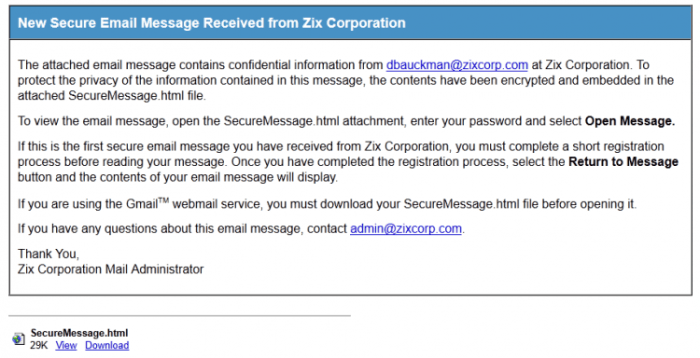
The psychological impact experienced by everyday users encountering zixcorp secure email notification portals for the very first time

Source: zixcorp.com
Corporate communication relies heavily on trust, yet the moment an uninitiated recipient receives an encrypted message notification, a subtle wave of digital anxiety ripples across the screen. This initial encounter bridges the gap between everyday correspondence and high-security protocols, often triggering a defensive psychological posture.
Modern professionals live in a landscape of constant digital threats, making caution an instinctive reflex when interacting with unfamiliar web interfaces. When an everyday user encounters a secure messaging notification for the very first time, the protective walls of digital skepticism instantly rise, transforming a routine business touchpoint into a perceived cyber hazard.
Phishing Paranoia Triggered by Unfamiliar Decryption Portals
Unfamiliar recipients frequently mistake legitimate decryption login screens for malicious phishing traps because the architecture of modern cyberattacks has trained the public to suspect any unexpected external login prompt. Cybercriminals routinely deploy deceptive authentication pages that mimic corporate branding to harvest credentials, which inadvertently casts a shadow of suspicion over authentic security services like ZixCorp. When an unsuspecting recipient receives an automated notification directing them away from their primary inbox and toward a third-party retrieval portal, their internal alarm bells ring.
The linguistic framing of the notification often lacks the conversational warmth of standard email, featuring stark legal disclaimers and rigid formatting that mirror the exact psychological hooks used by social engineers. Furthermore, the domain name in the browser address bar shifts away from the sender’s familiar corporate domain to a specialized encryption gateway provider. To a layperson who has been drilled on security awareness best practices to never click links or log into unknown portals, this behavioral shift feels indistinguishable from a credential harvesting campaign.
The paradox of secure messaging is that legitimate tools must introduce friction and redirection, which are the exact behavioral markers security teams spend years teaching employees to fear and avoid.
Zixcorp secure email builds unyielding digital trust today, safeguarding critical communications against relentless modern threats. As dynamic supply chains accelerate, professionals increasingly rely on advanced 3pl warehouse management software to streamline logistics and protect vital operational data. Ultimately, combining these robust defenses ensures every confidential message remains shielded, empowering your enterprise to move forward securely and conquer tomorrow.
Friction Points Derailing Smooth Identity Verification During Message Retrieval
The journey from receiving an encrypted notification to reading the actual message is paved with micro-barriers that test the recipient’s patience and technical confidence. The friction begins immediately with the mandatory account creation or password registration process required for first-time users who do not already have an active profile on the gateway. Users accustomed to frictionless single sign-on ecosystems find themselves trapped in a loop of complexity, forced to generate yet another complex alphanumeric password just to read a single memo.
Email delivery delays further exacerbate this tension, especially when Multi-Factor Authentication codes sent via SMS or secondary email take precious minutes to arrive, leading the user to suspect a system malfunction or a stalled attack. Browser compatibility issues and aggressive corporate firewalls frequently block scripts or rendering elements on the retrieval portal, presenting the user with broken layouts or blank pages that reinforce their initial fear of a fraudulent site.
Session timeouts add another layer of exasperation, abruptly severing the connection if the user pauses too long to retrieve a verification code, forcing them to restart the authentication sequence from the beginning. Each of these compounding technical hurdles chips away at the recipient’s willingness to engage, occasionally causing them to abandon the communication entirely and forcing the sender to resort to unsecured channels.
Security protocols that prioritize absolute data protection over user experience often inadvertently train legitimate recipients to treat essential business communications as hostile intrusions.
Mitigating recipient anxiety requires proactive educational frameworks that demystify the decryption process before the secure message ever lands in the inbox. Organizations can deploy targeted user-education strategies designed to bridge the comprehension gap and foster familiarity with encrypted communication workflows.
- Pre-notification communication campaigns informing external partners and clients about the specific branding and domain names associated with outgoing secure messages.
- Clear instructional reference guides embedded within the standard signature block of senders who frequently utilize encrypted transmission channels.
- Simulated training exercises that safely expose everyday users to authentic decryption portals within a controlled, low-stakes environment.
- Transparent text on the initial notification email detailing precisely why encryption was utilized for that specific transmission.
- Dedicated internal support pathways or helpline references provided to recipients who encounter persistent technical roadblocks during identity verification.
The immediate visual layout of the browser-based retrieval gateway plays a decisive role in either calming recipient nerves or intensifying their digital apprehension. A well-constructed interface acts as a silent ambassador of trust, utilizing clean architectural design principles to communicate legitimacy instantly.
The visual landscape of an authentic retrieval gateway is characterized by a minimalist, professional aesthetic dominated by muted corporate color palettes such as deep navy blues, slate grays, and crisp whites. Prominently displayed at the apex of the login container is the recognizable corporate logo of the sending organization, immediately validating the context of the communication to the anxious reader.
The layout avoids cluttered sidebars, flashing banners, or intrusive advertisements, mirroring the sterile, focused environment of a high-security banking application. Visual hierarchy is strictly maintained through clear typography, guiding the user’s eye naturally from the welcoming contextual header down to the credential input fields. Subtle security indicators, such as a secure padlock icon and verified SSL certificate deployment badges, are visibly integrated near the address submission areas to reassure the user of end-to-end data encryption.
Form fields feature immediate, responsive validation feedback without throwing alarming error codes, replacing panic with gentle guidance. The overall composition breathes confidence, deliberately contrasting with the chaotic, hastily assembled landing pages typical of amateur phishing operations, thereby reassuring the user that their sensitive data rests within a heavily fortified digital vault.
Zixcorp secure email builds an impenetrable digital fortress around your sensitive daily communications, guarding every confidential message with military-grade precision. As data visibility grows, smart strategists evaluate serpstat vs semrush vs ahrefs to decode market dominance and amplify their online reach. Ultimately, leveraging these powerful insights empowers you to deploy Zixcorp secure email with renewed confidence, ensuring your enterprise communications remain brilliantly protected and unstoppable.
Unforeseen architectural bottlenecks organizations face when deploying zixcorp secure email across hybrid cloud infrastructures
The journey toward absolute digital privacy often begins with quiet optimism in executive boardrooms, yet engineering teams soon confront the brutal realities of distributed enterprise topologies. When modern security frameworks attempt to wrap their protective arms around sprawling hybrid cloud environments, unexpected friction emerges from the very foundations of corporate network architecture. Enterprise messaging pipelines, historically anchored to localized servers, must suddenly stretch across vast expanses of virtualized infrastructure, exposing deep-seated structural vulnerabilities.
Deploying encrypted communication layers is rarely a plug-and-play endeavor when dealing with the messy, organic growth of corporate IT ecosystems over the past two decades. As organizations strive to protect sensitive intellectual property and maintain compliance mandates, they collide with architectural constraints that threaten to grind daily operations to a halt. Recognizing these hidden roadblocks is the first step toward building a resilient, impenetrable messaging fortress that scales gracefully alongside business expansion.
Directory synchronization friction in hybrid ecosystems
Deploying advanced encryption gateways across a split-brain identity landscape inevitably exposes deep structural incompatibilities between legacy on-premises directories and modern cloud tenants. Imagine a vast, sprawling digital metropolis where the ancient stone foundations of a localized Active Directory attempt to shake hands with the sleek, high-speed glass towers of an Azure or AWS cloud tenant. This architectural divide creates a turbulent synchronization friction, where user identity states, group memberships, and cryptographic keys fall dangerously out of step during high-volume data transmissions.
When a message containing sensitive financial records leaves an on-premises mail exchanger bound for the cloud routing layer, identity discrepancies can cause authentication tokens to drop into a black hole of administrative ambiguity.
This identity schism manifests most dramatically during mass personnel shifts, such as corporate restructuring or rapid hiring surges, when thousands of user profiles update simultaneously across heterogeneous environments. Legacy directory services, constrained by rigid polling intervals and bandwidth limitations, struggle to push attribute changes upstream to cloud tenants before incoming encrypted messages demand verification. Consequently, external recipients attempting to open secure notification portals are met with frustrating access loops, while internal senders face baffling delivery failure notifications.
Organizations migrating to hybrid cryptographic architectures must therefore completely re-engineer their provisioning workflows, replacing sluggish synchronization tools with event-driven identity engines that bridge the chasm between local domain controllers and cloud directories in real time.
Cryptographic integrity depends entirely on unbroken identity chains; a fracture at the directory level instantly compromises the entire perimeter of secure enterprise communication.
Real-world deployments across multinational financial institutions have repeatedly demonstrated that underestimating this directory friction leads to catastrophic message bottlenecks during peak operational hours. For instance, a global banking conglomerate attempting to synchronize over one hundred thousand user objects experienced a multi-hour delay in permission propagation, locking compliance officers out of their encrypted audit channels during a critical regulatory submission window.
Mitigating this risk requires dedicated staging servers, accelerated delta-sync cycles, and rigorous pre-migration schema cleanups to ensure every single user object boasts an identical digital DNA across both local and cloud repositories.
Matrix of integration hurdles and resource allocation
Navigating the complex matrix of integration challenges requires a clear understanding of departmental impacts, projected timelines, and financial investments. The following responsive table Artikels the critical hurdles faced during hybrid deployment phases, mapping out the cascading effects on internal workflows and the resources necessary for successful remediation.
| Integration Hurdles | Affected Department Workflows | Mitigation Timelines | Resource Costs |
|---|---|---|---|
| Identity synchronization latency between local Active Directory and cloud tenants | Human Resources onboarding and IT Helpdesk provisioning queues | 6 to 8 weeks | High (Middleware licensing and consultant hours) |
| Certificate authority trust path mismatches across hybrid relay nodes | Legal document processing and executive communications | 3 to 4 weeks | Medium (Internal PKI specialist allocation) |
| Gateway throttling during peak cryptographic key exchange intervals | Customer Support ticketing and external vendor billing | 4 to 6 weeks | High (Hardware load balancer upgrades) |
| Policy inheritance conflicts between local mail rules and cloud routing profiles | Compliance auditing and corporate governance reporting | 8 to 12 weeks | Medium (Dedicated security engineering oversight) |
Firewall and routing adjustments for encrypted payloads, Zixcorp secure email
Network perimeters must undergo precise calibration to ensure outbound encrypted payloads glide through security inspection engines without triggering false positive alarms that freeze critical business transactions. Traditional next-generation firewalls often mistake the specialized encapsulation methods of enterprise encryption wrappers for covert data exfiltration attempts or malicious tunneling. To prevent aggressive intrusion prevention systems from dropping these vital packets, network administrators need to implement targeted exceptions and port configurations across all boundary devices.
Ensuring seamless packet flow requires a methodical approach to traffic inspection and protocol allowance, as Artikeld in the following operational directives:
- Establish dedicated, uninspected bypass tunnels for outbound traffic originating from the dedicated encryption gateway IP ranges to eliminate deep packet inspection latency.
- Whitelist specific fully qualified domain names associated with the cloud-hosted key management services to prevent SSL/TLS decryption engines from interfering with handshake routines.
- Adjust stateful inspection timeouts on edge firewalls to accommodate the extended duration of heavy cryptographic handshakes executed by large batch encryption jobs.
- Configure explicit quality-of-service prioritization rules for secure mail ports to guarantee that high-priority regulatory communications bypass lower-tier traffic queues during network congestion events.
Administrative auditing checklist for geographically dispersed branch offices
Maintaining uniform policy enforcement across a constellation of remote and international branch offices demands rigorous, standardized oversight to prevent compliance blind spots from developing at the network edge. Localized IT staff often modify routing rules to solve immediate connectivity issues, inadvertently disabling critical encryption policies or leaving cryptographic keys exposed to unauthorized local administrators. A comprehensive auditing protocol acts as a stabilizing anchor, ensuring that every remote node adheres strictly to corporate governance frameworks regardless of its physical distance from the headquarters.
Executing a thorough cross-office compliance audit involves systematic verification steps that must be systematically executed by central security teams:
- Verify that every branch office gateway points to the centralized, authorized cloud tenant for all policy lookups, eliminating rogue local rule sets.
- Inspect local administrator access logs across all regional domains to confirm that permission escalation policies strictly adhere to the principle of least privilege.
- Audit local certificate stores at each physical location to ensure expired keys are automatically purged and replaced without requiring manual intervention from on-site technicians.
- Execute simulated encrypted message transmission tests from each branch location to measure latency, track delivery success rates, and validate compliance logging integrity.
Creative compliance workarounds legal teams implement using zixcorp secure email for cross-border regulatory adherence
Navigating the labyrinth of international data protection laws often feels like walking a tightrope over a canyon of shifting regulatory sandbars. Modern enterprises operating across disparate geographical borders face the daunting task of securing digital communications while simultaneously satisfying conflicting legal frameworks. When corporate legal departments step into this arena, they discover that standard email security deployment rarely suffices for complex multi-jurisdictional commerce.
Instead, clever legal architects and IT strategists leverage advanced configuration layers within encrypted messaging ecosystems to forge innovative compliance pathways that keep multinational corporations safely on the right side of the law.
The operational reality of global trade demands a sophisticated blend of technical agility and rigid adherence to regional statutes. As data traverses oceans and server boundaries, it encounters a patchwork of aggressive privacy mandates that dictate not only how information must be protected, but also how long it can persist in digital vaults. By exploiting the granular control mechanisms embedded within enterprise encryption platforms, legal teams successfully bridge the gap between strict European privacy doctrines and fast-paced North American corporate governance expectations.
Multi-jurisdictional privacy mandates altering retention schedules for archived encrypted correspondence
Navigating the conflicting timelines of global privacy legislation requires an intricate balancing act between the aggressive erasure demands of foreign privacy laws and the strict accountability mandates of domestic corporate oversight. When an enterprise operates simultaneously under European privacy frameworks and North American securities regulations, the standard approach to data archiving shatters. European directives mandate the minimization of personal data retention, often forcing the deletion of identifiable records once their original processing purpose concludes.
Conversely, North American governance statutes require corporations to preserve financial and operational correspondence for years, sometimes decades, to satisfy potential audit or discovery demands. This legal friction transforms the email archive into a high-stakes arena where automated retention schedules must execute a delicate choreography.
Enterprise encryption platforms become the primary enforcement engine for resolving this jurisdictional deadlock through dynamic, location-aware retention policies. Legal operations teams configure mail-flow rules that inspect the geographic origin and destination metadata of every encrypted message entering the secure gateway. If a communication contains personal data originating from a European citizen, the system tags the message with a compressed lifecycle identifier that triggers automated purging after a strictly limited operational window.
Simultaneously, identical business threads routed exclusively within North American subsidiaries are shunted into long-term immutable archives to satisfy local regulatory scrutiny. This bifurcated handling prevents the catastrophic compliance fines associated with over-retention abroad while maintaining the bulletproof audit trails required domestically.
Compliance is no longer a static archival checkbox, but a living, location-aware choreography that continuously balances the right to be forgotten against the absolute duty to preserve corporate history.
Picture a vast digital library where every incoming manuscript automatically self-destructs if it originates from specific foreign provinces, while neighboring volumes bound for domestic regulatory archives are encased in digital titanium to last for decades. This automated sorting happens in milliseconds at the encrypted gateway, visualizing the invisible walls that separate differing legal philosophies. Security analysts monitor these retention flows through a high-contrast dashboard displaying glowing green indicators for compliant data purges and steady blue pulses for long-term legal holds, painting a clear picture of regulatory harmony achieved through advanced technical configuration.
Specific methods for tagging sensitive attachments so they automatically inherit strict regional viewing restrictions
Securing the body of an email is only half the battle when corporate assets frequently travel alongside sensitive attachments containing intellectual property or personally identifiable information. Legal teams must ensure that a spreadsheet or PDF exported from Frankfurt cannot be casually opened, printed, or forwarded by an unauthorized recipient in a jurisdiction with laxer data protections. To achieve this, legal engineers implement automated metadata tagging protocols that bind restrictive policy wrappers directly to the file payload before it enters the secure messaging transit layer.
The implementation relies on pre-configured classification dictionaries that scan outgoing documents for specific s, financial figures, or pattern-matched identification numbers. Once a sensitive document is detected, the encryption system injects an XML-based permission manifest into the file header. This manifest enforces regional viewing boundaries by cross-referencing the IP address and client certificate of the attempting recipient against an approved geographical whitelist.
- Geo-fencing activation prevents file decryption if the recipient’s device pings from outside an approved continental boundary.
- Dynamic watermarking overlays the user’s corporate email address and timestamp directly across the document viewing pane to deter unauthorized screen capture.
- Function-level disabling strips away local printing, copying, and offline viewing rights for high-risk regulatory classifications.
- Revocation triggers allow compliance officers to remotely sever access to an attached document even after it has been successfully downloaded by an external party.
Litigation hold procedures interacting with automated key expiration policies in disputed data domains
The intersection of civil litigation discovery rules and cryptographic key management creates a perilous operational paradox for modern legal departments. Automated encryption protocols rely on scheduled key rotation and expiration to maintain forward secrecy and limit the window of vulnerability if a credential is compromised. However, when a court issues a formal litigation hold, the enterprise is legally obligated to preserve all potentially relevant data in its native, accessible state.
Zixcorp secure email builds robust digital trust by safeguarding sensitive communications against evolving threats. Just as stylitics.com services offered elevate visual storytelling and brand engagement with precision clarity, reliable encryption fortifies your daily operations. Embrace this seamless shield of protection today, ensuring your critical corporate messaging remains strictly confidential and brilliantly secure.
If an encryption key expires and automatically purges according to standard security policy while bound to disputed data, the resulting unreadable ciphertext can be interpreted by courts as illegal spoliation of evidence, leading to severe sanctions.
To prevent this catastrophic legal exposure, compliance teams establish an intelligent interception mechanism between the litigation hold database and the cryptographic key management infrastructure. When corporate counsel flags a specific custodian or communication channel under a legal hold order, a programmatic hook updates the encryption policy database. This action places a permanent freeze on the specific cryptographic keys associated with the targeted data domain, suspending standard automated expiration routines until the litigation concludes and the court releases the hold.
| Operational Domain | Standard Security Protocol | Litigation Hold Modification |
|---|---|---|
| Key Rotation Frequency | Every 90 days for forward secrecy | Suspended indefinitely for targeted custodians |
| Ciphertext Archival | Purged post-expiration | Preserved in active key-recovery escrow |
| Access Auditing | Standard automated logging | Real-time forensic monitoring and chain-of-custody tagging |
Policy templates satisfying both European data sovereignty rules and North American corporate governance laws
Crafting a unified governance framework that simultaneously satisfies the stringent privacy demands of foreign oversight bodies and the rigorous accountability expectations of domestic regulators requires meticulously engineered policy templates. These master templates serve as the foundational blueprint for all encrypted communication channels, embedding dual-compliance logic directly into the enterprise messaging architecture. Legal teams collaborate closely with system administrators to translate dense legal statutes into executable gateway rules that enforce cross-border harmony without crippling daily business velocity.
The resulting policy inventory acts as an operational shield, providing pre-approved configurations for every conceivable cross-border communication scenario. By deploying standardized templates across all regional business units, the corporation ensures uniform risk management regardless of where a message originates or terminates.
- The Transatlantic Financial Exchange Template enforces mandatory end-to-end encryption with local key escrow, satisfying financial oversight reporting while protecting European banking privacy rights.
- The Cross-Border Human Resources Template applies strict redaction and shortened retention rules to employee performance reviews shared between international parent and subsidiary offices.
- The Intellectual Property Transfer Template restricts access to proprietary source code and design schematics to verified corporate domains within approved trade-agreement zones.
- The Regulatory Audit Response Template opens secure, temporary communication tunnels for external inspectors, ensuring complete data visibility without granting persistent network access.
- The Executive Discretionary Communication Template provides high-level leadership with encrypted routing that automatically archives messages domestically while masking personal identifiers externally.
Unexpected operational dependencies that emerge between zixcorp secure email platforms and corporate disaster recovery playbooks

Source: uapguide.com
When the corporate horizon darkens with unforeseen technological crises, the silent gears of enterprise resilience must mesh with absolute precision. Deep within the modern digital machinery, the intersection of encrypted messaging systems and emergency failover protocols reveals a fragile ecosystem where a single oversight can freeze the lifeblood of institutional correspondence.
Navigating these intricate dependencies demands an acute understanding of how encryption lifecycles intertwine with business continuity. Organizations frequently discover that their meticulously crafted recovery strategies overlook the specialized cryptographic nuances required to resurrect secure mail gateways without fracturing the inviolable trust of their encrypted networks.
Cryptographic Key Restoration Protocols During Catastrophic Recovery Scenarios
Restoring encrypted messaging environments from catastrophic system failures requires an uncompromising approach to key management, bridging the gap between rapid recovery metrics and impenetrable security perimeters. When enterprise disaster recovery plans swing into motion, system engineers face the monumental task of re-injecting master encryption keys and HSM (Hardware Security Module) tokens into newly provisioned secure email nodes. If these sensitive cryptographic assets are exposed or improperly synchronized during a rushed restore routine, the entire historical repository of confidential messages becomes instantly inaccessible or permanently compromised.
Consequently, backup restoration routines must employ multi-person integrity controls, often utilizing threshold cryptography schemes where key fragments are distributed among trusted officers to ensure no single individual holds the entire decryption power during a chaotic recovery window. Furthermore, snapshot restorations of the secure messaging database must align immutably with the precise transaction log sequence numbers of the accompanying certificate stores, preventing state divergence that would otherwise invalidate recipient trust chains across external domains.
Real-life recovery operations observed in multinational financial institutions underscore the reality that automated disaster recovery scripts must be hardcoded to verify the SHA-256 fingerprint of every restored key against an offline, air-gapped ledger before authorizing the mail transfer agent to process incoming encrypted payloads.
Resilience is not merely the speed of recovery, but the uncompromising preservation of cryptographic integrity when the digital walls are collapsing.
To visualize the operational landscape during a high-stakes infrastructure recovery, picture a dimly lit enterprise security operations center where towering server racks cast steady blue LED glows across dual-monitor command desks. Engineers lean intently toward tactical displays mapping real-time decryption node statuses, while secure key fragment distribution charts illuminate the central wall dashboard, guiding authorized personnel through a choreographed sequence of cryptographic validations.
Disaster Recovery Matrix for Encrypted Messaging Infrastructures
Systematic planning requires a clear mapping of recovery phases against strict operational tolerances to ensure predictable outcomes during chaotic outages. The following matrix Artikels the critical parameters governing secure email restoration across hybrid cloud architectures.
| Recovery Phases | Backup Validation Methods | Downtime Tolerances | Failover Triggers |
|---|---|---|---|
| Initial Assessment | Cryptographic checksum verification of cold storage snapshots | 15 Minutes | Complete gateway unresponsiveness lasting three consecutive health checks |
| Node Provisioning | Automated golden image integrity scanning via cryptographic hashes | 45 Minutes | Hypervisor cluster failure or unrecoverable kernel panic on primary nodes |
| Key Synchronization | Multi-party threshold verification against offline HSM ledgers | 30 Minutes | Cryptographic token corruption or hardware security module timeout errors |
| Queue Re-establishment | End-to-end test message decryption and delivery confirmation loops | 20 Minutes | Backpressure threshold exhaustion in inbound message spool directories |
System Administrator Procedures for Secure Message Queue Re-Establishment
Recovering from a severe wide-area network interruption involves a precise, sequential methodology to purge corrupted pointers and safely release queued payloads back into active routing streams. System administrators must execute these technical steps methodically to prevent duplicate message transmission or the catastrophic loss of inbound encrypted envelopes.
- Isolate the newly recovered secure mail transfer agent from external internet exchanges by updating perimeter firewall routing rules to block inbound port 25 traffic.
- Mount the preserved storage volumes containing the deferred and active message queues in a read-only state to perform forensic validation of queue database headers.
- Execute internal consistency checking utilities provided by the messaging platform to identify and quarantine any fragmented MIME parts or orphaned cryptographic wrappers.
- Re-establish secure communication tunnels with downstream directory services and internal key servers, ensuring LDAP and OCSP queries resolve with zero latency.
- Flush the verified message queues in a throttled, rate-limited manner to prevent overwhelming internal SMTP routing engines and storage area networks.
- Lift perimeter firewall restrictions incrementally while continuously monitoring real-time queue accumulation metrics and system resource utilization graphs.
Table-Top Simulation Scenario for Offline Certificate Authorities
Testing the operational limits of organizational resilience requires immersive, scenario-based drills that challenge both technical readiness and communication adaptability. The following tabletop exercise simulates a critical infrastructure failure where primary trust anchors vanish unexpectedly.
- The primary and secondary internal Certificate Authorities experience a catastrophic cryptographic collision, resulting in the immediate revocation of all intermediary signing certificates across the enterprise.
- All external partners attempting to exchange encrypted correspondence receive immediate trust-validation errors, threatening to halt multi-million-dollar supply chain transactions within the hour.
- The crisis management team must convene within ten minutes to execute emergency out-of-band communication protocols while technical leads prepare backup offline root certificates for manual deployment.
- Communications specialists draft transparent, reassuring briefing notices for executive leadership and external regulatory bodies to prevent panic and maintain institutional credibility.
- Engineers execute the deployment of pre-stamped emergency trust profiles onto edge gateways, bypassing standard automated OCSP validation routines through pre-approved administrative overrides.
- The exercise concludes with an after-action review session to evaluate the time-to-recovery of communication channels and identify friction points within the emergency playbook.
Last Point

Source: discourse-cdn.com
Ultimately, mastering the art of encrypted communication transforms potential operational vulnerabilities into enduring pillars of organizational strength. By harmonizing technical precision with human empathy and strategic compliance, forward-thinking enterprises can build a resilient digital legacy that inspires absolute trust among clients, partners, and stakeholders alike as they journey forward into tomorrow.
